Something has shifted quietly but significantly in the world of property law over the past few years, and I think it is worth talking about because I have watched it cost buyers and vendors dearly.
The traditional model was straightforward. You engaged a solicitor or family lawyer to handle your conveyancing. They were legally trained, thorough, and came with the full weight of a law firm behind them. For complicated transactions involving difficult titles, caveats, special conditions or anything that required genuine legal expertise, that model still makes a great deal of sense. A good property solicitor is an asset in a complex deal.
But something else has emerged alongside the traditional model. Licensed conveyancers are specialists in exactly one thing, the legal transfer of property. They do not handle wills or corporate matters or litigation. They do property, all day, every day. They answer their mobiles. They work outside business hours. They are reachable on a Saturday afternoon and at nine o’clock on a Tuesday night. In property, that availability is not a courtesy. It is often the difference between a deal happening and a deal falling apart.
“In property, the person who answers the phone at 9pm is often worth more than the person with the most impressive qualifications.”
I have seen this play out more times than I can count. A buyer has found the property they want. Negotiations have been long and hard. By late afternoon both parties are ready to exchange unconditionally. The momentum is real, the emotional commitment is at its peak, and the vendor just wants it done. But the buyer’s solicitor is unavailable. Perhaps they are in court, perhaps they have simply gone home. While that call goes unanswered, another buyer steps in. The deal is gone.
The reverse happens just as often on the vendor’s side. A buyer has been pushed to their limit through a long day of negotiation and is ready to exchange. The vendor’s solicitor cannot be reached. The buyer goes to bed. By morning the emotional momentum has gone and so has the deal. I have watched this happen more times than I would like.
None of this is a criticism of solicitors as a profession. A complicated contract, an unusual title, a property with genuine legal complexity, these are exactly the situations where you want a fully trained property lawyer at your side. But for a straightforward residential purchase or sale, the question worth asking is not who has the most impressive qualifications. It is who will pick up the phone when it matters.
■ FROM THE ARCHIVES
 The Great Exodus from Braeburn
EVENING NEWS (SYDNEY) · WEDNESDAY 22 OCTOBER 1930 · PAGE 1
· Chattels Rowed Away in Skiffs
· Emptying Kirribilli Private Hotel
“Extraordinary scenes, recalling the flight of war refugees, were witnessed during the exodus of tenants from the Hotel Braeburn at Kirribilli today. Faced with the stern realities of having the bailiffs on the premises, of there being no possibility of getting a meal, and of having the carpets auctioned from under their feet at noon, residents of this fashionable Kirribilli establishment tumbled out in unceremonious fashion.” Evening News, 22 October 1930
Ninety-six years ago this month, the guests of one of Kirribilli’s grandest waterfront establishments found an elegant solution to a most inelegant problem. The bailiffs were at the front door. The harbour was at the back. The answer was obvious.
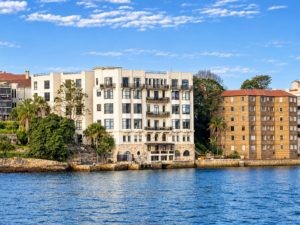
The Hotel Braeburn, long known to locals as the Astoria, was a large private hotel and block of flats on Waruda Street that almost overhung the water. On the evening of Tuesday 21 October 1930, the landlady’s son went quietly from table to table in the dining room with some unwelcome news. Bailiffs had taken possession of the building. All rooms were to be vacated by the following morning. The contents would go under the hammer at noon to cover the rent owed by the landlady, Mrs L M McCormick, who was herself lying ill in hospital.
Two boarders well known in Sydney’s Bohemian circles, who had rooms on the harbour side, were the first to see the opportunity. They hired boats from local sheds, rowed them quietly around to the water frontage of the hotel, and began passing their possessions out through the back windows. The idea spread rapidly. Tables and bookcases, radio sets and gramophones, canaries in their cages, tennis racquets, golf clubs and even pet dogs were lowered on ropes into waiting skiffs and rowed away across the harbour to fresh fields and pastures new, as one paper rather beautifully put it, while the bailiffs conscientiously guarded the front door on the opposite side of the building.
On the land side, motor lorries, cars and carts lined the narrow roadway. The stairways became so choked that belongings went missing in the crush. One guest, a Mr Maplestone, was spotted climbing the stairs with a couple of picture frames under his arm, described by the Daily Pictorial as a particularly forlorn figure. A girl shielded her caged canary from the crowd. A flushed faced lady tried to explain the whole business to a screeching parrot. Most took it in good humour.
The auction at noon was a bonanza for anyone who turned up. Double beds went for half a crown. Wardrobes for three shillings. Chairs for a shilling apiece. The neighbouring boarding houses did well too. Their proprietors arrived offering rooms to the newly homeless, and local papers noted, with some pointedness, that rents in several of them rose sharply after six o’clock that evening.
There was genuine sympathy for Mrs McCormick. It was 1930, the Depression was biting hard across Sydney, and she had been known for her generosity to tenants who had lost their jobs. The story was picked up by newspapers from Rockhampton to Kalgoorlie. Kirribilli’s great waterfront escape had become national news.
Today The Braeburn Hotel is now filled with luxurious apartments in the building known as 1 Waruda Street Kirribilli (Pictured below)
DO YOU KNOW MORE?
Each month I include a piece of local history that most people have never come across. If you have family connections to the Hotel Braeburn, the Astoria, or any of the streets and buildings mentioned here, I would genuinely love to hear about them. If you would like a copy of this month’s A5 history card posted to you, just reply to this email.
Discuss the harbourside market with David:

